7 Illustration Styles That Boost Brand Recognition
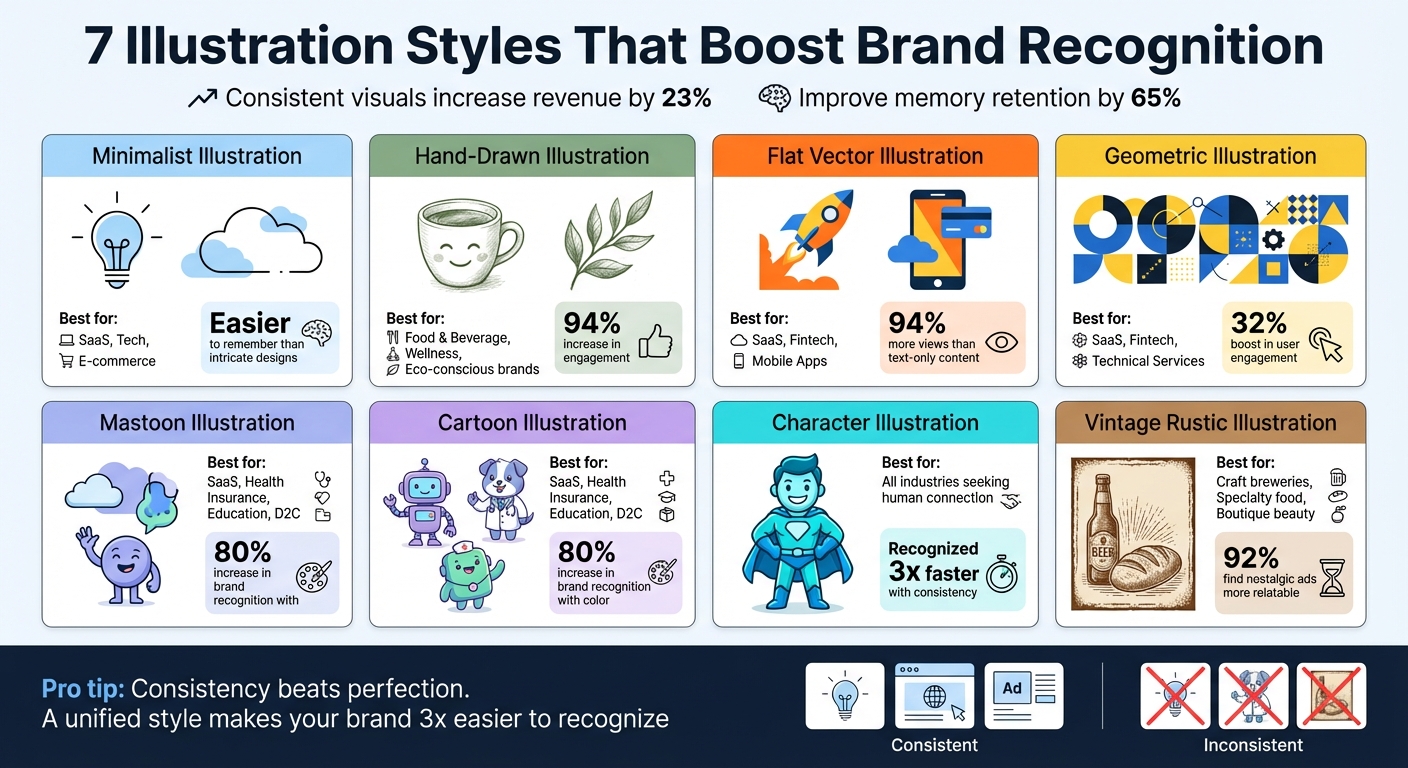
Your brand’s visual identity plays a critical role in how people perceive and remember it. Research shows that consistent visuals can increase revenue by up to 23% and improve memory retention by 65%. But maintaining brand consistency across platforms can be challenging, especially as teams grow. The solution? Choosing the right illustration style and sticking to it. You can even create custom illustrations tailored to your specific needs.
Here are seven effective styles that can help create a strong, recognizable brand identity:
- Minimalist Illustration: Clean lines, limited colors, and simplicity for clarity and trust.
- Hand-Drawn Illustration: Adds a personal, human touch with natural imperfections.
- Flat Vector Illustration: Bold shapes and colors for easy recognition and scalability.
- Geometric Illustration: Structured designs using basic shapes for a modern, logical feel.
- Cartoon Illustration: Playful visuals that simplify concepts and create emotional connections.
- Character Illustration: Develops a relatable persona to humanize your brand.
- Vintage Rustic Illustration: Nostalgic designs that highlight heritage and craftsmanship.
Each style works best for specific platforms and industries, from SaaS and tech to e-commerce and consumer goods. Tools like IllustrationsAI simplify the process, ensuring consistency and speed across all your assets.
Pro Tip: Consistency beats perfection. A unified style across all platforms makes your brand easier to recognize and remember.
Explore these styles to find the one that aligns with your brand’s personality and message.
7 Illustration Styles for Brand Recognition: Visual Comparison Guide
3 ways to use illustration for branding
1. Minimalist Illustration
Minimalist illustration relies on clean lines, intentional use of negative space, and a limited color palette to create visuals that are instantly recognizable. When used consistently, this style becomes a visual shortcut that helps your audience immediately identify your brand.
Visual Impact on Brand Recognition
By removing unnecessary details and focusing on clarity, minimalist designs ensure that your message stands out. Studies reveal that minimalist logos are easier to remember compared to more intricate designs. As RevoluteX Digital explains:
"Minimalist branding isn't about stripping your identity bare - it's about cutting the distance between curiosity and action".
This approach uses simplicity to convey balance, sophistication, and professionalism - qualities that build trust and encourage engagement. It also enhances user experience by making navigation more intuitive, a crucial factor in successful digital marketing [11, 13].
Suitability for Different Platforms
Minimalist illustrations perform well across a variety of platforms. On e-commerce websites, they create a clean and trustworthy atmosphere, keeping the focus on your products. For SaaS and tech sites, small, simple illustrations near feature lists help users understand complex ideas without overwhelming them with text. On mobile apps, where space is limited, minimalist visuals shine in onboarding flows, empty states, and micro-interactions.
Social media platforms also benefit from this style. Simple, hand-drawn doodles or clean outlines can add personality to your ads and posts while remaining easy to process during quick scrolling sessions. Considering that tweets with images get 150% more retweets than text-only posts, and visual content garners 94% more views overall, minimalist illustrations must grab attention quickly. AI tools make it easier to achieve this consistency across your visuals.
Ease of Creation Using AI Tools Like IllustrationsAI
AI tools simplify the process of creating minimalist illustrations while ensuring consistency. Platforms like IllustrationsAI offer pre-configured styles such as "Notion", "Flat 2D", and "Dropbox", which align with modern design trends. By inputting your brand colors, themes, and desired compositions, you can generate polished illustrations in just minutes.
These tools allow you to standardize elements like line thickness, corner radius, and color palette, ensuring a cohesive look across your marketing materials. Structured prompts make it easy for team members to maintain a unified visual identity, no matter the platform. Plus, with multiple export options - SVG, PNG, AI, EPS, and JPG - your assets are deployment-ready immediately. Brands that maintain consistent visuals are recognized up to three times faster by users.
2. Hand-Drawn Illustration
Hand-drawn illustrations bring a sense of warmth and personality through natural strokes, pencil textures, and intentional quirks that highlight the artistry behind them.
Visual Impact on Brand Recognition
Did you know that the human brain processes visuals 60,000 times faster than text? This is why brands that incorporate original artwork often see engagement levels rise by as much as 94%. Sayyidath Sahla from Hapx Digital sums it up perfectly:
"Hand-drawn illustrations... reflect craftsmanship and individuality, something stock images often lack".
These natural imperfections - like variations in line weight and texture - signal authenticity. They make your brand feel approachable and relatable, steering away from an overly polished, sterile look.
Suitability for Different Platforms
Hand-drawn illustrations adapt beautifully across a variety of platforms. On social media, the loose and imperfect linework stands out, giving your content a more personal, human feel compared to generic visuals. For e-commerce sites and packaging, these illustrations add character and storytelling, turning ordinary products into memorable experiences. This visual style also translates seamlessly into digital marketing campaigns.
In the world of SaaS and tech platforms, the "Tactile Tech" trend is gaining traction. This approach combines clean vector elements with organic textures like grain or stippling, making even the most complex technical ideas feel relatable and easy to grasp.
Hand-drawn visuals are especially effective for brands in food and beverage (think artisanal watercolor styles or organic products), wellness, eco-conscious businesses, and charities looking to convey a "crafted with care" message. Even tech companies in sectors like fintech, cybersecurity, and DevOps are using this style to simplify abstract concepts and build trust with their audience.
Alignment with Brand Personality
This illustration style is a perfect match for brands aiming to appear playful, charming, witty, or even a little rebellious. The design trend for 2026 leans heavily toward rejecting "machine-perfect" imagery in favor of work that feels "messy, human, and meaningful". As the Global Art Curators Team at ARRIVAL explains:
"In 2026, 'wonky' is no longer a weakness. It's the point".
Hand-drawn elements let brands tell authentic stories. For instance, in January 2026, design agency BUCK collaborated with Notion to create an animated, hand-drawn AI assistant character. To retain the "handmade quality" of Roman Muradov's original sketches, the team used cel animation. This technique allowed the character's expressions - like "thinking" or "listening" - to shift naturally, keeping the crafted, non-digital feel intact. Interestingly, this level of authenticity is achievable even when using AI tools.
Ease of Creation Using AI Tools Like IllustrationsAI
AI tools now make it easier than ever to scale hand-drawn styles without losing their charm. Platforms like IllustrationsAI let you generate custom illustrations by uploading brand reference images and tweaking parameters like stroke weight, texture, and "roughness." The tool exports in versatile formats (SVG, PNG, AI, EPS, JPG), ensuring your visuals are ready for any channel.
To avoid visuals that feel too polished, layer organic textures - like grain or stippling - over clean shapes. Creating style templates with consistent parameters (line weight, color palette, and texture) ensures your brand's visuals stay uniform across platforms. This consistency matters: presenting a cohesive brand image can boost revenue by up to 23%.
3. Flat Vector Illustration
Flat vector illustration simplifies visuals by focusing on clean shapes, bold colors, and straightforward silhouettes. It uses basic geometric forms - like circles, squares, and triangles - to create designs that are modern, scalable, and easy to recognize. By eliminating textures and gradients, this style prioritizes clarity, making it perfect for quick comprehension. Its streamlined look not only enhances recognition but also works seamlessly across various digital platforms.
Visual Impact on Brand Recognition
Flat illustrations have a unique strength: they’re easy for the brain to process. Their simplicity allows users to recognize and remember visuals more quickly, forming stronger associations with a brand. Studies show that coherent visual systems improve memory retention by 65%. As IBM's Design Language team explains:
"The flat style's reliance on simple, bold silhouettes allows for more expressive performances and evocative motion".
Small, focused illustrations can anchor content, making it easier for users to grasp key benefits without wading through dense text. In fact, content that includes relevant visuals gets 94% more views than text-only material. The precise nature of flat design - with consistent stroke widths, smooth corners, and fixed color palettes - also communicates reliability and professionalism.
Suitability for Different Platforms
Flat vector illustrations thrive in digital environments because they’re built using scalable technology. As vector-based assets, they stay sharp on any screen, whether it’s a smartphone or a 4K monitor. On social media, flat illustrations make eye-catching visuals for platforms like X (formerly Twitter), LinkedIn, and Facebook, driving higher click-through rates. For e-commerce sites, they turn dull bullet points into engaging "How It Works" sections, guiding customers through features in a visually appealing way.
These illustrations are also ideal for SaaS and tech platforms, where lightweight SVG files ensure fast page loads - critical for keeping conversion rates high. Mobile apps often use flat styles in onboarding flows, empty states, and interface elements because they remain clear and effective on any screen size. As GetIllustrations puts it:
"A product screenshot shows what your tool looks like. An illustration shows what it feels like to use it".
Alignment with Brand Personality
Flat vector illustrations align perfectly with brands that value precision and modernity. They convey a sense of being vibrant, user-friendly, and forward-thinking, making them a go-to choice for SaaS, fintech, and tech brands. Companies like Monzo, Slack, and Duolingo use flat-style icons and characters to maintain a digital presence that’s both playful and professional.
This approach is especially effective for brands aiming to appear organized and efficient. The clean aesthetic reduces visual clutter, helping users focus on the core message. A newer trend, "Tactile Flat Design", adds subtle organic textures - like grain or stipple effects - onto flat shapes. This technique softens the engineered look, giving products a more human touch without losing the clean, polished feel.
Ease of Creation Using AI Tools Like IllustrationsAI
AI tools make it easier than ever to produce flat vector illustrations while maintaining a consistent style. Platforms like IllustrationsAI let you create "Style Templates" by uploading reference images and setting parameters like stroke weight, corner radius, and specific hex color codes. These structured prompts ensure that every illustration stays aligned with your brand’s visual identity, preventing inconsistencies.
IllustrationsAI also supports various export options, with SVG being the most versatile format. SVG files stay crisp and scalable across all platforms, making them ideal for flat illustrations. To keep designs precise, you can use an 8px snap-to-grid system and stick to standard angles (15°, 30°, 45°, 60°, 75°, 90°) for geometric shapes. This level of detail not only enhances the overall look but also builds trust with users by signaling professionalism and attention to detail.
4. Geometric Illustration
Geometric illustration relies on circles, squares, triangles, and polygons to craft designs that feel modern, structured, and easy to recognize. Unlike flat 2D vector styles, these illustrations use mathematical patterns and relationships to create visuals that are both intricate and clear. This approach works because our brains are naturally wired to identify and remember basic geometric shapes more quickly than detailed drawings. The result is a clean, timeless visual style that can make your brand stand out while maintaining a logical, harmonious feel across all your visuals.
Visual Impact on Brand Recognition
Our brains are great at recognizing patterns, and geometric designs take full advantage of this ability. Simple shapes like circles and triangles don’t fall out of style like trendy illustrations, saving brands from frequent redesigns. These designs also use Gestalt principles - proximity, similarity, and closure - to create visuals that feel unified and easy to process.
For example, in 2024, Linearity updated their Linearity Curve software to include comprehensive geometric design tools. This change led to a 32% boost in user engagement and a 45% increase in subscriptions from professional designers. Geometric designs offer both aesthetic appeal and practical advantages, making them a solid choice for brands aiming to balance style with functionality.
Suitability for Different Platforms
Geometric illustrations adapt well across various platforms, especially for industries like SaaS, fintech, and technical services, where they convey precision and professionalism. Companies like Intercom use geometric isometric illustrations to simplify complex SaaS concepts, making them more approachable. Similarly, DigitalOcean incorporates deep blue tones and geometric shapes to communicate seamless cloud services, helping users visualize intricate infrastructure.
In e-commerce, geometric designs often appear on product packaging and delivery materials, creating a sleek, upscale impression. For social media, modular geometric templates allow brands to maintain a consistent look across campaigns. In mobile apps and UI design, structured geometric layouts reduce cognitive load, guiding users through content effortlessly.
| Platform Type | Best Geometric Application | Brand Signal |
|---|---|---|
| SaaS / Fintech | Isometric illustrations, dashboards | Precision, reliability, clarity |
| E-commerce | Packaging, delivery graphics | Modernity, stability, premium feel |
| Social Media | Modular templates, campaign icons | Consistency, brand recognition |
| Technical | Blueprints, schematic visuals | Rigor, logic, technical expertise |
Alignment with Brand Personality
Geometric design doesn’t just improve clarity - it also helps brands express their personality. Symmetrical designs communicate stability and trust, ideal for established companies, while asymmetrical layouts convey energy and creativity, making them perfect for startups. Theodore Cipolla, a Design Director, puts it best:
"Geometric design isn't just about making things look good - it's about creating visual systems that function intuitively while communicating brand values instantly".
Brands can also choose between literal and surreal geometric styles. Literal styles, like blueprints or schematics, are great for explaining how products work. On the other hand, surreal geometric art uses imaginative, dreamlike forms to showcase innovation. The blueprint aesthetic, with its monolinear icons and technical illustrations, is gaining traction, especially among technical audiences who value precision.
Ease of Creation Using AI Tools Like IllustrationsAI
AI tools like IllustrationsAI make creating geometric illustrations faster and more consistent. By using structured prompts (e.g., JSON-based frameworks), these tools let you define parameters like stroke weight, corner radius, and hex color codes. This "Co-Pilot" workflow allows you to generate 10–15 design concepts in minutes, refining the best ones to fit your brand style.
You can also use AI to build modular systems, designing reusable geometric components that ensure consistency across platforms like social media and websites. For technical brands, IllustrationsAI supports isometric perspectives and schematic styles, making it easier to explain complex systems clearly. Plus, with multiple export options - SVG, PNG, AI, EPS, JPG - you can ensure your designs look sharp on everything from smartphones to 4K monitors.
5. Cartoon Illustration
Cartoon illustrations bring a playful and approachable vibe to your brand. They simplify complex ideas and create emotional connections through familiar, human-like features - a psychological effect known as pareidolia. This helps spark curiosity and makes your brand more memorable, which can lead to stronger recall and recognition.
Visual Impact on Brand Recognition
The stats don't lie: color alone can increase brand recognition by 80%. Cartoon illustrations take this a step further by crafting unique visual identities that grab attention instantly. For example, in 2017, health insurance provider Oscar used cartoon ads on New York subways, featuring characters snapping photos of medical issues with smartphones. Within just six weeks, their membership numbers doubled. Similarly, in 2024, eCommerce company Bolt collaborated with Superside to create a cartoon-style explainer video. By assembling a team of 18 designers, Bolt boosted their creative output by an astonishing 600% in just one month.
Suitability for Different Platforms
Cartoon illustrations thrive in industries like SaaS, fintech, health insurance, education, and direct-to-consumer brands, where simplifying complex ideas is key. On social media, they create shareable, emotionally engaging content. In e-commerce, they can guide customers through product features or even enhance packaging for a memorable unboxing experience. For mobile apps and websites, cartoons can turn frustrating moments - like 404 error pages or empty dashboards - into delightful interactions that leave a positive impression. A great example is Battersea Dogs & Cats Home, which rebranded with hand-drawn watercolor illustrations. This warm, humane touch perfectly aligned with their mission to rescue animals.
Alignment with Brand Personality
Cartoon illustrations do more than just look good - they help define your brand's personality. The style of the cartoon should reflect your brand's core values. For instance, cheeky or rebellious characters work well for disruptive brands like Ugly Drinks, while soft, hand-drawn characters are ideal for empathetic brands like Battersea. A standout example is fintech startup Anna (Absolutely No Nonsense Admin), which used quirky animal illustrations by Alice Bowsher to make administrative tasks feel less intimidating for creative professionals. As Meg Robichaud, Illustration Lead at Shopify, puts it:
"Illustration is likeable. You have a greater willingness to try new things when you like them. You are more understanding when things go wrong if you like them".
This emotional connection can strengthen customer relationships and even make users more forgiving during product hiccups.
Ease of Creation Using AI Tools Like IllustrationsAI
Cartoon illustrations also benefit from advancements in AI tools like IllustrationsAI, which ensure consistency across all your assets. These tools help solve a common challenge in cartoon branding: keeping characters consistent. Features like preserving facial details, hairstyles, and body types eliminate the risk of character drift. You can adjust poses or expressions - like waving, smiling, or running - without losing the character's identity. IllustrationsAI allows you to create a base character and save it as a reference for future campaigns. With export options in formats like SVG, PNG, AI, EPS, and JPG at 2K resolution, your assets are ready for immediate use across digital and print platforms. Tasks that used to take 20 hours can now be completed in just 30 minutes with AI.
6. Character Illustration
Character illustrations offer a way to give your brand a relatable, human element. By creating a persona that reflects your brand's values and personality, you make your business more approachable and trustworthy. A well-crafted character can bridge the gap between an abstract brand and its audience, fostering emotional connections and making your brand feel more personal. This visual element also plays a key role in building a cohesive and memorable brand identity.
Visual Impact on Brand Recognition
A thoughtfully designed character becomes a visual signature for your brand, helping you stand out and improving recognition. Think of the Geico Gecko, the Michelin Man, or Mailchimp's "Freddie" chimp - these characters have become inseparable from the brands they represent. Similarly, Octopus Energy's pink mascot is instantly recognizable. Research supports this: consistent visuals can be recognized up to three times faster than inconsistent ones. Moreover, maintaining a consistent brand presentation, including character design, has been linked to revenue increases of up to 23%.
Suitability for Different Platforms
Characters aren't just visually striking - they're versatile. They can seamlessly adapt to various platforms and contexts, whether it's social media, e-commerce, or your website. On social media platforms like Instagram or YouTube, they grab attention and encourage sharing. In e-commerce, they enhance product packaging and make your items pop on the shelf. On websites and apps, they can enrich the user experience. For instance, hero banners featuring characters can communicate your brand's story in just a few seconds. They can also make onboarding flows feel more engaging or turn error pages into moments of delight. A great example is SecurityScorecard's collaboration with Superside in 2024, where they created a comic book universe of product heroes. This project produced over 500 visuals, redefining B2B storytelling.
Alignment with Brand Personality
Your character needs to align with your brand's core identity. The artistic style you choose should reflect your audience and values. For example, Gen Z often prefers bold, dynamic 3D illustrations, while Millennials may lean toward hand-drawn or nostalgic designs. Additionally, the character's personality should match your brand archetype. Here are some examples:
- Sincerity: Honest and cheerful, ideal for brands like Disney or Kellogg's.
- Excitement: Energetic and daring, fitting for Red Bull or Airbnb.
- Competence: Reliable and intelligent, suited for companies like Apple or Microsoft.
- Sophistication: Glamorous and elegant, aligning with brands like Rolex or Tiffany & Co.
- Ruggedness: Outdoorsy and tough, perfect for Jeep or Harley-Davidson.
As Phoebe Ohayon, Head of Design at Voice Branding, says:
"Think of your AI character like a great employee - purpose comes before personality".
Ease of Creation Using AI Tools Like IllustrationsAI
With advancements in AI, creating custom character illustrations has never been easier. Tools like IllustrationsAI allow you to generate characters from simple text descriptions and reference images, ensuring they align with your brand's style. You can customize everything from hairstyles and facial features to outfits and poses. Whether you prefer 3D, watercolor, or flat design, these tools help you create characters that fit seamlessly into your visual identity. Plus, you can export them in various formats (SVG, PNG, AI, EPS, JPG) at high resolution, complete with commercial-use licenses and custom illustration packs for consistent use across all marketing materials.
7. Vintage Rustic Illustration
Vintage rustic illustrations bring a sense of nostalgia that can reinforce a brand's heritage and emotional appeal. By incorporating elements like hand-etched textures, woodcut effects, and distressed finishes, this style evokes memories and a comforting sense of belonging. It signals a brand with history and experience, creating the impression of a "time-tested" legacy that consumers are more likely to trust.
Visual Impact on Brand Recognition
In a world dominated by sleek, modern designs, vintage rustic illustrations stand out with their warm, hand-drawn charm. Research shows that 92% of consumers find ads more relatable when they evoke nostalgia. Brands like Fentimans and Jack Daniel's are prime examples. Fentimans’ vintage logo featuring the founder's dog, "Fearless", has remained iconic for over a century. Similarly, Jack Daniel's "Old No. 7" badge and rugged ornamental borders reinforce its authority and heritage. These elements not only boost recognition but also create a strong emotional connection with their audience.
Suitability for Different Platforms
This style thrives on various platforms, including social media, e-commerce, and product packaging. For e-commerce, vintage rustic illustrations can enhance product labels, website banners, and other visuals that emphasize craftsmanship and authenticity. Trader Joe's, for instance, uses hand-drawn vintage illustrations across its stores and online presence, creating a distinct identity. In March 2023, Pepsi modernized its 1990s logo for its 125th anniversary, blending retro aesthetics with the Y2K trend to appeal to both older and younger audiences. These examples show how vintage designs can adapt to modern platforms while retaining their nostalgic charm.
Alignment with Brand Personality
This style works particularly well for brands that emphasize authenticity, tradition, or artisanal quality. Think craft breweries, distilleries, wineries, specialty food brands, or boutique beauty labels. If your brand values heritage or craftsmanship, vintage rustic illustrations can strengthen that identity. However, it’s essential to strike a balance - pair vintage elements with modern layouts and fonts to avoid looking outdated. To connect with your audience, identify the era that resonates most - whether it’s the 1950s, 1970s, or 1990s - and incorporate its colors and typography.
Ease of Creation Using AI Tools Like IllustrationsAI
Designing vintage rustic illustrations used to require specialized skills, but AI tools like IllustrationsAI have made it much simpler. By uploading reference images and using prompts with terms like "matte", "recycled", or "distressed textures", you can quickly transform modern photos into retro-inspired visuals. The platform also allows for batch processing, enabling you to apply consistent vintage filters across large inventories and export in multiple formats (SVG, PNG, AI, EPS, JPG) with commercial licenses. Whether you’re creating social media templates or e-commerce visuals, these tools ensure a cohesive vintage look without needing expert design knowledge.
This timeless style not only differentiates your brand but also makes it easier to stay consistent across platforms, thanks to AI-powered tools that simplify the process. By blending nostalgia with modern technology, you can craft a visual identity that feels both familiar and fresh.
How IllustrationsAI Creates These Styles for Your Brand
IllustrationsAI makes it easy to maintain a consistent visual identity by offering over 15 predefined styles, including options like Minimalist, Flat 2D, and 3D SaaS. These styles are designed to deliver polished results instantly, earning a 4.9/5 rating from users for their quality and ease of use. But it doesn’t stop there - customization lets you adapt these styles specifically to your brand.
With the custom style training feature, you can teach the AI to replicate your brand’s unique look. Upload 10–15 reference images that highlight your brand’s colors, textures, and patterns, and the system will learn to create assets that align seamlessly. The platform also includes centralized Brand Kits, where you can store essential elements like logos, hex codes, and typography. These guidelines are then applied automatically to every design, ensuring consistency across all platforms. And consistency matters - a cohesive brand presentation can increase revenue by up to 23%.
"Brand consistency isn't just a design preference - it's a business imperative." - svgapp.ai
Export options include SVG, PNG, AI, EPS, and JPG formats, all with full commercial licensing. For example, SVG files - typically under 10KB - enhance website speed and deliver sharp visuals, while PNG files are ideal for handling gradients and textures.
Whether you start with a predefined style or create a custom one, IllustrationsAI helps you maintain a cohesive visual identity. Plans start at just $12/month, and you can explore unlimited variations without needing to enter credit card details until you find the perfect match for your brand.
Conclusion
These seven illustration styles - from minimalist to vintage rustic - offer a versatile toolkit for crafting a unified brand identity. Research shows that consistent visuals are recognized three times faster than inconsistent ones, and cohesive visual systems can boost memory retention by 65%. By using the same illustration style across your website, social media, and marketing materials, you're not just presenting a polished image - you’re creating a system that helps customers quickly understand your message and remember your brand more effectively. This kind of visual consistency simplifies communication while reinforcing the key values your brand stands for.
Choosing the right illustration style goes beyond aesthetics; it’s about expressing your brand’s personality and values. For instance, hand-drawn illustrations convey warmth and a personal touch, geometric styles suggest precision and trustworthiness, while cartoon illustrations evoke playfulness and approachability. Trying out different styles can help you uncover the visual language that clicks with your audience. After all, what resonates with a fintech startup might not work for a lifestyle brand.
"Consistency beats creativity. A website with one stunning illustration and nine mismatched ones looks worse than a website with ten 'good enough' illustrations that share the same style." - GetIllustrations
IllustrationsAI breaks down the barriers that have traditionally made professional illustrations inaccessible to small businesses. There’s no need for design expertise or pricey software. Simply upload 10–15 reference images, and the platform replicates your chosen style across endless variations. With flexible pricing and a risk-free trial - no credit card required - you can explore and refine your brand’s visual identity with ease.
Take the first step today. Memorable brands are built on consistent, standout visuals.
FAQs
To pick the right illustration style, start by thinking about your brand's identity, your audience, and the importance of consistency. What message do you want your visuals to send? Your style should align with your brand's personality and values. For example, a playful, colorful style might resonate with younger audiences, while a sleek, polished look could appeal to corporate clients.
Once you've nailed down the vibe, consider using tools like AI to experiment with different styles. This can help you create visuals that not only stand out but also tie together into a cohesive and recognizable identity.
Yes, combining different illustration styles can be effective when approached carefully. To keep your brand recognizable, focus on maintaining visual harmony through consistent elements like color schemes, overarching themes, or design principles. By choosing styles that complement each other and align with your brand’s character, you can introduce variety without creating visuals that feel disconnected. The trick lies in striking the right balance between creativity and uniformity, ensuring your brand stays cohesive and memorable.
AI brings consistency to the table by crafting structured style guides and setting precise visual standards tailored to your brand. These tools standardize elements like colors, styles, and overall aesthetics, ensuring every visual aligns seamlessly with your brand identity. On top of that, AI-driven platforms simplify the process by automatically generating illustrations that stay true to your brand. This not only cuts down on inconsistencies but also keeps your visuals cohesive across e-commerce platforms, social media, and marketing channels.

Meet the Author
Vignesh Rao Y
Vignesh is driven by ideas that create a tangible impact. At Illustrations AI, he specializes in content that helps designers and marketers speed up their creative workflows. When he's not turning complex ideas into simple visuals, you might find him lost in a book, jotting down ideas in his notebook, or connecting the dots others overlook.